Teaching
Graduate Courses
- PHYS 520 - Statistical Physics
- PHYS 545 - Advanced Experimental Methods in Materials Science (Lab Manual)
- PHYS 595 - Colloquium
- SCED 502 - Physical Science Application for K-5 Teachers
Undergraduate Courses
- PHYS 100B - General Physics
- PHYS 151 - Mechanics and Heat
- PHYS 152 - Electricity and Magnetism
- PHYS 152 Lab - Electricity and Magnetism (Lab Manual)
- PHYS 152 Online - Electricity and Magnetism
- PHYS 152 Online Lab - Electricity and Magnetism (Lab Manual)
- PHYS 320 - Thermodynamics
- PHYS 360 - Introduction to Computational Physics (Lecture Notes)
- PHYS 385 - Materials Science (Concepts of Solar Cells)
- PHYS 385L - Materials Science Lab (Dye Sensitized Solar Cells)
- PHYS 385C - Materials Science Colloquium
- PHYS 422 - Statistical Physics
- PHYS 445 - Advanced Experimental Methods in Materials Science (Lab Manual)
- PHYS 495 - Colloquium
Publications
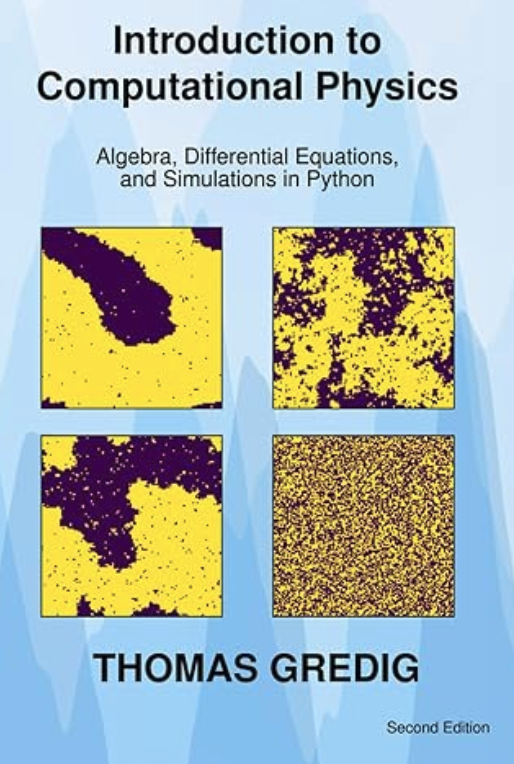
The book “Introduction to Computational Physics: Algebra, Differential Equations and Simulations in Python” is now available on Amazon.
Computational physics is now a core part of undergraduate science, mathematics and engineering programs. This self-contained course emphasizes hands-on learning, reproducibility, and computational thinking within the physics context using Python. It integrates core principles outlined by the American Association of Physics Teachers and supports readers in developing a strong computational foundation for research projects.
Designed with minimal prerequisites, this text equips readers with essential technical computing skills through Python programming, Jupyter notebooks, and Quarto for science reproducibility. Readers are guided through numerical algorithms, matrix algebra, data visualization, differential equations, Monte Carlo simulations, and stochastic processes. Realistic examples are drawn from classical mechanics, electricity and magnetism, statistical physics, and quantum mechanics:
- Computations of projectile motion with drag, driven damped mass-spring systems, Lotka-Volterra model and double pendulum
- Non-linear regression and data fitting
- Units, uncertainties and error propagation
- Symbolic algebra for Lagrangian mechanics
- Solving 1D heat diffusion and Schrödinger’s equation
- Monte Carlo simulations and Markov chain generation
- Brownian motion, percolation and 2D Ising model